
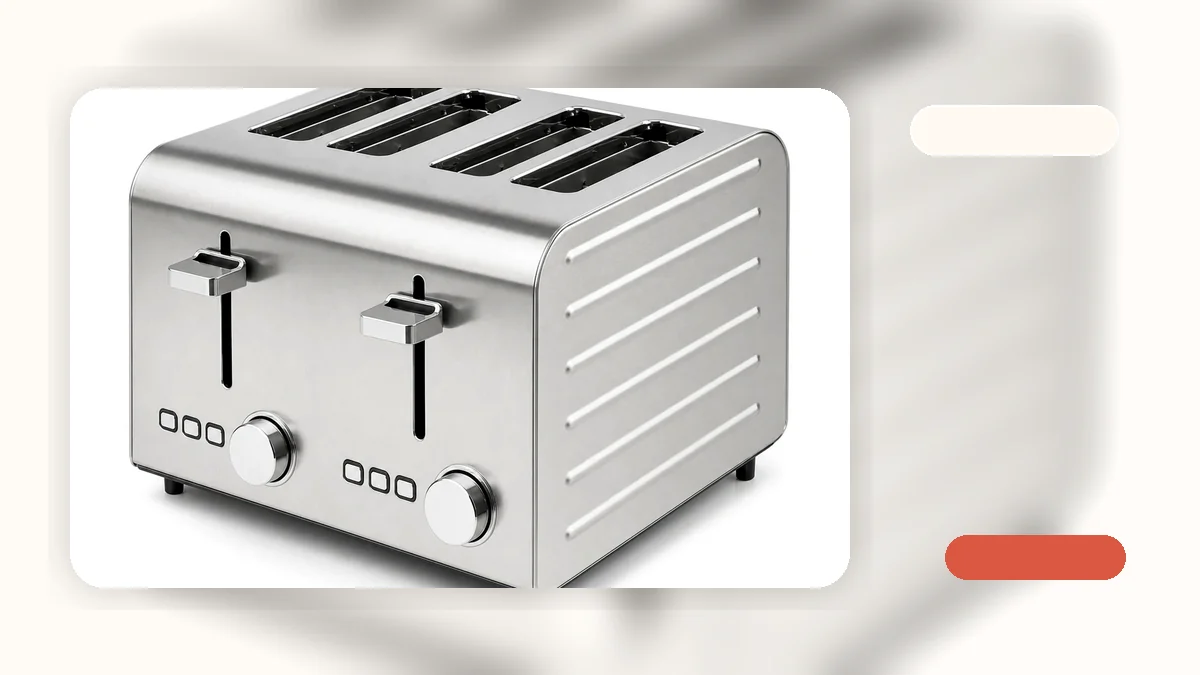
Stainless 4-Slice Toaster: How to Choose the Right One for Your Kitchen
Shopping for a stainless 4-slice toaster sounds simple — until you start comparing slot widths, shade controls, crumb trays, and counter footprints. The stainless steel finish is the most common style you will find in U.S. toaster aisles, and a 4-slice model is the default size for couples, families, and anyone who makes more than two pieces of toast at breakfast. But “stainless steel” and “4-slice” alone do not tell you whether a toaster will actually fit your bread, your counter, or your morning routine.
This guide walks through what to check before you buy, how to decide between a 4-slice and a 2-slice model, and which features matter for everyday use — so you can choose a 4-slice toaster stainless steel model that makes sense for your kitchen, not just your shopping cart.
Why Stainless Steel Matters in a 4-Slice Toaster
When you see “stainless steel” on a toaster listing, it usually refers to the outer housing — the panels you see and touch on your countertop. In practice, this is the most popular finish for American toasters because it matches stainless refrigerators, dishwashers, and most modern kitchen décor without requiring any extra effort.
Here is what the material actually affects in daily use:
- Appearance: Stainless-style housings look clean and modern. They blend into most kitchens without standing out or clashing.
- Cleaning: Stainless steel is easier to wipe down than textured plastic, but it does show fingerprints more easily. If fingerprints bother you, plan on a quick wipe with a microfiber cloth every few days.
- Durability: Stainless steel housings tend to feel sturdier than plastic ones, though the internal heating components are similar across price ranges.
What the housing material does not change is how the toaster heats your bread. Toasting performance depends on wattage, heating element design, and slot configuration — not the exterior finish. A stainless steel 4-slice toaster will not toast faster or more evenly than a plastic model with the same wattage and element layout.
For buyers replacing an older appliance, a stainless 4-slice model is the natural mid-range default. It is not a premium upgrade over other materials — it is simply the most widely available style. You can browse our full 4-slice toaster collection to compare finishes, features, and sizes side by side, or start with our general toaster buying guide if you want a broader overview first.
What to Check Before You Buy a Stainless Steel 4-Slice Toaster
Once you have settled on a stainless steel toaster 4 slice size, the real decisions are about the features inside. Here are the five specs that matter most for daily breakfast use.
Slot Width
Standard toaster slots are roughly 2.8 to 3.5 cm wide (about 1.1 to 1.4 inches). That is fine for regular sandwich bread. But if you toast bagels, Texas toast, sourdough, or thick-cut artisan slices, wider slots make a noticeable difference. A slot that is too narrow means you force bread in, it gets stuck, or it browns unevenly because it is pressed against the heating elements. If bagels are part of your weekly breakfast, check the listed slot width before anything else.
Shade Control
Look for at least 5 to 7 browning settings with clear markings. Whether the control is a dial or a digital button matters less than whether you can repeat your preferred shade consistently. The first few mornings with any new toaster are trial and error — once you find your number, you want to be able to set it and forget it.
Crumb Tray
A removable crumb tray is not a bonus feature. It is the difference between a toaster that stays clean with weekly emptying and one that smells burnt within a month. In my experience, the crumb tray design is one of the first things people stop noticing — until the burning smell starts. A tray that slides out easily and sits flat on the counter for emptying is worth more than a fancy digital display.
Controls and Presets
Most 4-slice toaster stainless steel models include defrost, reheat, and cancel buttons. These are useful. Defrost handles frozen bread and waffles without extra thought. Reheat warms cold toast without over-browning. Cancel lets you stop mid-cycle if you smell trouble. Digital or touch controls look modern and can be easier to read, but they add cost without changing how your toast turns out.
Counter Footprint
A 4-slice toaster is roughly 11 to 13 inches wide and 7 to 9 inches deep. That is about twice the counter width of a 2-slice model. If your kitchen has limited counter space, measure the spot where you plan to put it — including clearance for the lever and any cord management.
For a closer look at a model that offers all three size options with standard controls, the Stainless Steel Toaster with 2-Slice, 4-Slice, and 6-Slice Options includes 3.8 cm wide slots, 7 shade settings, and defrost, reheat, and cancel buttons with a removable crumb tray.
4-Slice vs. 2-Slice: Which Stainless Steel Toaster Fits Your Morning?
The 4-slice size is the default recommendation for couples and families, but it is not automatically the right choice. Here is a practical way to think about it.
A 4-slice toaster makes sense when:
- Two or more people eat breakfast at roughly the same time — it cuts waiting in half.
- You regularly toast different types of bread (sandwich bread and bagels, for example) and want to run them simultaneously.
- Your counter can handle the extra width without feeling crowded.
- The model has dual independent controls, so each pair of slots can run at a different shade setting — useful when one person likes light toast and the other prefers dark.
A stainless steel toaster 2 slice makes more sense when:
- You live alone and toast one or two slices at a time.
- Your kitchen is an apartment, dorm, or small space where counter room is limited.
- You mostly toast sandwich bread for one person — a compact stainless 2-slice toaster uses less energy and less space.
A stainless steel two slice toaster is often the smarter purchase for single-person households. It leaves more counter room for other prep, and most people do not need four slices of toast at once. If you are leaning toward the smaller size, the Compact Stainless 2-Slice Toaster with 6 Shade Settings is a practical option with a small countertop footprint. For a cleaner, more modern control style, the Stainless Steel 2-Slice Toaster with Touch Controls offers touch-style buttons and 6 shade settings in a compact stainless housing.
One more format to know about: long-slot 4-slice models. Sometimes sold under names like “elite cuisine stainless steel 4 slice long slot toaster,” these use two elongated slots instead of four standard ones. This is a good fit for longer bread slices — sourdough, artisan loaves, or irregularly shaped bread. However, long slots can be narrower than standard wide slots, so check the listed width if you regularly toast thick bagels. A stainless 2 slice toaster in a long-slot format can also work if you mostly toast long artisan slices for one or two people.
Common Mistakes When Shopping for a Stainless Steel Toaster
After reading toaster product pages and buyer feedback, a few patterns come up again and again. Here are the most common mistakes — and what to do instead.
- Assuming “stainless steel” means all metal. Most models have stainless-style housing with plastic internal components. This is standard construction, not a defect. The housing looks and feels like stainless steel; the internal parts are designed for heat resistance and cost efficiency.
- Overpaying for features you will not use. Digital displays, one-touch presets, and smart connectivity look appealing on a product page. But if your breakfast is two slices of bread with butter, those extras do not improve your toast. Focus on slot width, shade control, and crumb tray first.
- Ignoring crumb tray design. A tray that is hard to remove or too shallow will cause odor and smoke issues within weeks of daily use. Check product images or descriptions to see how the tray slides out.
- Not measuring counter space. A 4-slice stainless steel toaster is roughly 11 to 13 inches wide. In a small apartment kitchen, that is a real amount of counter real estate. Measure before you buy.
- Buying on appearance alone. A retro or color toaster can look great in your kitchen. But if the slots are too narrow for your bread or the crumb tray is difficult to access, the look will not help you at 7 a.m. on a Tuesday.
Keeping Your Stainless 4-Slice Toaster Clean and Working Well
Stainless steel is generally easier to maintain than textured plastic, but it does require some attention to stay looking clean and working well.
- Wipe the housing regularly. Use a damp microfiber cloth. Avoid abrasive cleaners or steel wool, which scratch the surface and leave permanent marks.
- Empty the crumb tray weekly. Accumulated crumbs are the most common cause of burning smells and minor smoke. A clean crumb tray also helps the toaster heat more evenly.
- Always unplug first. Before cleaning or moving the toaster, unplug it and let it cool down. This sounds obvious, but it is the most important safety step for any countertop appliance.
- Expect a smell on first use. A faint burning plastic smell during the first one or two cycles is normal — it is residual factory coating burning off. Ventilate the kitchen and run one or two empty cycles. If the smell persists after three uses, stop using the toaster and contact the manufacturer.
- Keep the area around the toaster clear. Crumbs that fall outside the tray build up around and behind the toaster. A small brush or a quick wipe keeps the area tidy and reduces fire risk.
A clean toaster lasts longer and performs more consistently. It is the kind of maintenance that takes two minutes a week but makes a real difference over months of daily use.
FAQ: Stainless 4-Slice Toaster Questions
What is the difference between a stainless steel toaster and a regular toaster?
Stainless steel refers to the housing material and appearance. It does not change heating performance — that depends on wattage, heating element design, and slot configuration. A stainless steel toaster and a plastic toaster with the same internal specs will toast similarly.
Is a 4-slice toaster worth it for one person?
Usually not. A 2-slice toaster saves counter space and energy. A 4-slice stainless steel model makes sense when two or more people eat breakfast at the same time, or if you freeze bread and toast multiple slices in batches.
What does “long slot” mean in a 4-slice toaster?
It means two elongated slots instead of four standard ones. This fits longer bread slices like sourdough and artisan loaves. However, check the listed slot width if you regularly toast thick bagels — long slots can be narrower than standard wide slots.
How wide should toaster slots be for bagels?
Look for slots at least 3.5 cm (about 1.4 inches) wide. Standard slots around 2.8 cm may be too narrow for a cut bagel, which means you have to force it in or trim it down. Wide slots handle bagels, Texas toast, and thick-cut bread without resistance.
How do I clean fingerprints off a stainless steel toaster?
Wipe with a dry or slightly damp microfiber cloth. For stubborn marks, use a small amount of stainless steel cleaner or diluted white vinegar. Avoid abrasive pads — they scratch the surface and make fingerprints more visible over time.
Find the Right Stainless 4-Slice Toaster for Your Kitchen
Choosing a stainless 4-slice toaster comes down to a few practical questions: How wide are the slots? How many shade settings does it offer? Is the crumb tray easy to remove? Will it fit on your counter? Once you know what to look for, the comparison gets much simpler.
Browse our 4-slice toaster collection to compare models by slot width, shade control, and counter footprint — and find the one that fits your morning routine.