
I. From Aroma to Smoke: The “Signals” of Problems Are Often Hidden in Everyday Life
A slice of toast in the early morning should be golden, crispy, and fragrant. However, many people have experienced this: as soon as the button is pressed, white smoke billows from inside the toaster, the air is filled with a burnt smell, and the machine casing is even hotter than usual. Many people subconsciously think this is a “normal phenomenon,” but in fact, these signs are often the toaster’s “cries for help.”
Smoke and abnormal heat don’t necessarily mean the machine is about to break down, but they do send a signal—your toaster may be overloaded, or there may be internal carbon buildup or abnormal heat conduction. Understanding the causes of these phenomena is a crucial step in extending machine life and ensuring safety.
II. Internal residue buildup: The most common and easily overlooked culprit
In most cases, the smoke isn’t caused by an electrical problem but rather by accumulated breadcrumbs. The toaster’s heating element generates high temperatures with each use, and if the crumbs aren’t cleaned regularly, they gradually carbonize.
At high temperatures, these crumbs are repeatedly baked and burned, creating visible smoke. This is especially noticeable when using bread with sugar, jam, or butter; the residual sugars and fats can produce a slightly burnt smell when heated, making it easier to mistakenly believe the machine is malfunctioning.
Regularly emptying the crumb tray at the bottom is the simplest way to prevent this problem. For older models without a tray, it is recommended to invert the machine and gently tap it to clean it every week to prevent carbonized residue from adhering.
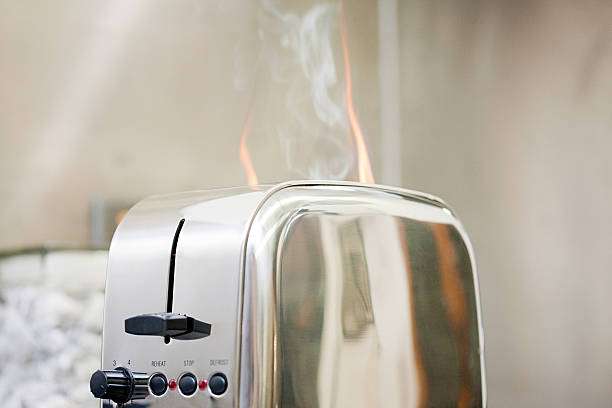
III. Excessive power or poor ventilation: The hidden logic behind abnormal heating
A toaster typically relies on a metal heating wire and a reflective cavity to achieve heating. If it is run for a long time or used in a confined space (such as close to a wall or cabinet), the heat cannot be effectively dissipated, resulting in a significant increase in the temperature of the outer casing.
Some users also like to bake the device in multiple rounds, causing the internal temperature to accumulate. Although it may seem normal in the short term, this overheating will accelerate the aging of the heating element and can also easily cause the power cord connection to loosen or the plastic parts to deform.
If the casing becomes hot to the touch, the top changes color, or unusual noises are heard, stop using it immediately, unplug it, and check it after it has completely cooled down. It is best to use it in a well-ventilated environment and avoid proximity to flammable materials.
IV. Humidity and Food Differences: “Pseudo-Abnormalities” Not Caused by Electrical Faults
Not all smoke indicates a malfunction. For example, when a new machine is used for the first time, the internal metal or anti-rust coating evaporates when heated, producing a little white smoke; this is a normal “start-up period.” Additionally, if the bread contains a high layer of syrup, cheese, or butter, localized scorching may occur during baking.
The key to determining the cause at this point is whether the smoke has a burnt or pungent smell. If it’s just a slight amount of moisture or white smoke, it’s usually a normal evaporation reaction. Conversely, if it’s accompanied by a pungent odor, unusual machine noises, or a significant increase in temperature, it may be due to aging circuitry or burning food residue.

V. Heating Wire Aging and Circuit Problems: Dangerous “Delayed Explosion Point”
As toaster heating wires age, their surface gradually oxidizes, reducing thermal conductivity and causing uneven temperature distribution. This results in some areas overheating while others remain too cool, leading to uneven heating and potentially causing the insulation layer to burn, thus creating a short-circuit risk.
If the following signs appear, the equipment should be sent for repair or replacement as soon as possible:
After being plugged in, the machine has a delayed start-up or intermittent power outages.
The bread was unevenly browned during baking, with one side being noticeably redder.
The casing may show signs of deformation, scorch marks, or unusual noise.
the toaster with a new, safer one.
VI. Maintenance and Usage Recommendations: Make the Machine “Breathe” More Smoothly
Keeping your toaster in good condition lies not in complicated operations, but in regular cleaning and a scientific usage rhythm.
Clean after use only when the device has cooled down to prevent debris from getting stuck in crevices at high temperatures; perform a deep cleaning once a month to prevent the accumulation of charred material; avoid frequent plugging and unplugging of the power supply during use to prevent short-term current surges; Do not cover with a damp cloth or towel to keep the heat dissipation channels clear.
These seemingly minor actions can effectively slow down machine aging, ensuring that each slice of toast is made at the perfect temperature.
VII. From Smoke to Peace of Mind: The Bottom Line of Home Appliance Safety
A toaster may seem like a minor issue, but it is actually a microcosm of home electrical safety. Many accidents stem from the underestimation of a single instance of smoke. It’s not just a fleeting fright but a subtle warning.
When we learn to listen to these signals, we can find the root of the problem in the initial anomaly. This will stop the machine from “struggling” to work and allow the kitchen to return to its proper peace and aroma.